Tuesday, July 29, 2008
Sisters of Mercy, 'Floodland', 1987

The Joe Man turned me on to this monster record back in 89/90. 'Lucretia My Reflection', and 'This Corrosion' are the tracks that hooked me. I'm sure I have them on some cassette mix-tape somewhere, but I need the vinyl.
Pop Will Eat Itself, 'Dos Desdos Mis Amigos', 1994

Rob Kendall, my roommate for much of 94-99, had this record. I don't know about the whole album, but the lead-off track, 'Ich Bin Ein Auslander', is total bad ass shit. I need it, hope it was released on vinyl.
Radiohead, 'The Bends', 1995

Radiohead's second effort, 'The Bends' is probably their best effort, made back when they were actually concerned about writing good songs.
Spiritualized, 'Pure Phase', 1995

Again, Rob Kendall turned me on to Spiritualized, as well as Spacemen 3, Jason Spaceman's former band. 'Pure Phase' is mindblowingly good, featuring 'Let It Flow', 'Lay Back In the Sun', and 'Medication' among other odes to opiates.
Nine Inch Nails, 'Fixed', 1992

The companion piece to the 'Broken' EP, 'Fixed' features absolutely insane remixes of tracks from 'Broken'. 'Fixed' scared the shit out of me.
Ministry, 'Psalm 69', 1992

The epitome of Industrial Metal, and Ministry's finest moment, 'Psalm 69' scared the shit out of me as well. Gibby's vocal on 'Jesus Built My Hotrod', and William Burroughs' spoken word on 'Just One Fix' help place this record at the top of the Sickest Shit Ever list.
Pigface, 'Notes from the Underground', 1994

Another Kendall discovery, Pigface is the brainchild of Martin Atkins, and features a revolving cast of characters including Al Jourgensen, Genesis P. Orridge, and Jello Biafra among other total nutjobs. 'Chikasaw', featuring Lesley Rankine (Ruby), just blows me away.
Saturday, July 26, 2008
5) Kiss - 'Won't Get Fooled Again', Mid Hudson Civic Center, 1984
4) The Replacements - 'Happy Birthday' (to Keith), Meadowlands, 1989
3) Microdot - 'Left of the Dial', Tedstock, 2005
2) Georgia Satellites - 'I Wanna Be Sedated', The Chance, 1988
1) Marillion - 'Tonight I'm Gonna Rock You, Tonight', The Ritz, 1987
Friday, July 25, 2008
Ian Astbury formed Southern Death Cult in the Post-Punk climate of Britain, 1981, and along with Bauhaus and Sisters of Mercy (among others), helped define what has become known as Goth.
Southern Death Cult lasted a cozy year and a half before disbanding. Then Ian met guitarist Billy Duffy, and formed Death Cult.

After releasing a self titled EP in 1983, the band dropped the 'death' in an effort to garner a broader appeal.
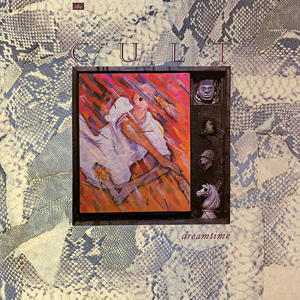
A year later the band emerged from Rockfield Studios in Wales with the 'Dreamtime' record. Duffy's highly processed guitars and Astbury's developing powerhouse vocal style carry the record which suffers from less than great production. The frequent lyrical references to American Indian culture on 'Dreamtime' coupled with the resonant tenor quality of Astbury's voice inevitably conjure up a Jim Morrison vibe that he has done little to distance himself from, and much to exploit.

In 1985 a much more well defined and focused LP, 'Love', was released, containing the band's breakthrough single, 'She Sells Sanctuary'. Not entirely devoid of their Post-Punk roots, on 'Love' The Cult favor a more Psychedelic sound courtesy of Billy Duffy's penchant for signal processing, and the much improved production provided by Steve Brown.
To date, The Cult had developed their sound steadily and a clear direction, each ensuing release a more mature, more evolved take on the same sonic idea, that of layers, effects, and lots of whooshy-whoosy. In 1986 they took a fork in the road, a fork that lead to a complete overhaul of their sound.
Initially The Cult began work on their next album with Steve Brown, but after tracking had wrapped, they weren't happy with the sound. They asked the then up and coming producer Rick Rubin to remix the record. Rubin, who at that point had produced three records: LL Cool J's 'Radio', the Beastie Boys 'Licence To Ill', and Slayer's masterwork 'Reign In Blood', demanded that they re-record the album with him at the helm.
The first thing Rick Rubin did was to take away all of Billy Duffy's effects pedals. He stripped the band's sound down to highlight the great Duffy riffs that were buried in the heavy application of whooshy-whoosh.

The result was 'Electric', a decidedly Hard Rock record wherein The Cult completely abandoned the Post-Punk and Psychedelia, and totally embraced the Big Guitar sound of, well, AC/DC basically. Rick Rubin made a Mutt Lang Hard Rock record while Mutt was busy making Pop stars out of the formerly Hard Rock band Def Leppard.
'Electric' was refreshing in it's blatant derivative-ness. The Cult gave us the Hard Rock that the Hard Rock bands had stopped giving us, and they found a very receptive audience for it. That was fortunate for the band, as the new direction was a veritable slap in the face to the Goths and Punks who had supported them up to that point.
With the success of the single 'Love Removal Machine', and the support of MTV, 'Electric' established The Cult in America. A world tour followed, and the band gained a Zepplinesque reputation for tour behaviour.

Producer Bob Rock was brought in for 1989's 'Sonic Temple', and Bob let Billy have some of his toys back, though the lesson was learned, and the focus on Big Riffs remained. 'Sonic Temple' launched four singles, including 'Fire Woman', and 'Edie (Ciao Baby)', and launched The Cult to the top of the Rock heap - a difficult place to keep a foothold.
The lack-lustre 'Ceremony' followed. Astbury and Duffy were at odds. The magic was gone, and the ensuing records consistently failed to measure up. By the mid 90's the band was on hiatus, and Astbury engaged in some side projects. A brief reunion, complete with sub-standard album, came and went, and then Astbury left to join the Doors.
The Cult has recently reformed again. I'm not sure I care.
I picked up a couple more slabs o' vinyl the other day.
'This Is the Moody Blues'

I've never been too keen to invest in a Moody Blues record. My feelings about the Moody Blues are luke warm at best. There are a couple of songs I like, so when I saw this greatest hits package from 1974 for 2 bucks, I figured what the hell, right? Well, when I more closely inspected the record at home I discovered that it was a two record set issued in one sleeve (I hate when they do that), and only one of the discs was inside. The song I like the most, 'Questions', was on the disc I did get, as well 'Legend of a Mind'. I did not get 'I'm Just a Singer (In a Rock and Roll Band)' or 'Nights In White Satin'. I think I'll survive.
I listened to both sides, and I'm even more convinced that there's no reason to dig deeper into The Moody Blues. Why is The Moody Blues often referred to as Progressive Rock? I'd lump them in wherever you put Procul Harum and Jethro Tull.
'Radio K.A.O.S.'

My first solo Waters record. I've heard much of his solo stuff through Chrispy. I like this one better than 'The Pros and Cons of Hitchhiking', which sounds to me like Roger had Clapton come in for one day to toss off leads willy nilly all over the record in an effort to display his lack of need for Gilmour. 'Radio K.A.O.S.' seems a bit more focused.
Tuesday, July 22, 2008
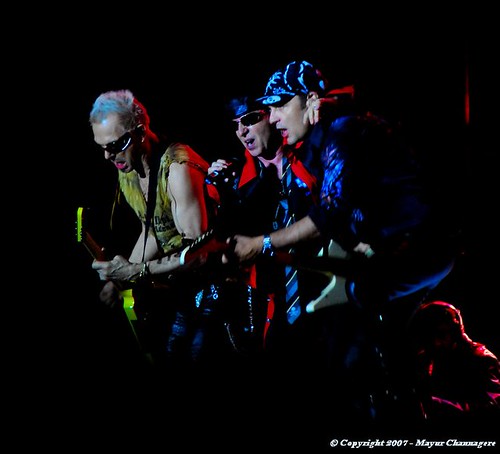
Skorpionalben der Oberseite 10:
1) Lovedrive
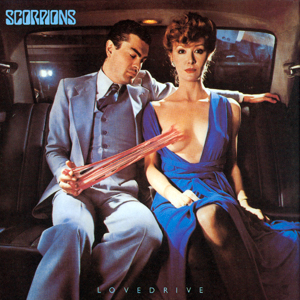
Certainly sporting the greatest album cover of all time, 1979's 'Lovedrive' is a tour de force. Top to bottom, front to back, not a weak track on it.
In 1978 guitarist Ulrich Roth left the band amicably to pursue his hendrixian style unhampered by Klaus and Rudy's heavier, more accessible, and less cluttered brand of ass kicking Rock. They were still pals, and Uli even provided them with a replacement in the form of young protege Matthias Jabs.
Work began on 'Lovedrive' at producer Dieter Dierks' studio in Koln (Cologne) with Jabs providing competent and commendable contributions, but the stakes were high. The Scorpions were on the cusp of breaking in America, and competent and commendable wasn't enough; the Scorpions needed great. Matthias was put on waivers. He had the gig, but they wanted him to sit out the proceedings for a bit and keep developing his guitar skills. They could afford to do so because around the same time Rudy's brother Michael had just left UFO and was available to join his old band in the studio. In the end Michael played lead on three songs (including 'Another Piece of Meat'), Matthias appears on three, and Rudy handled the rest himself ('Holiday', 'Coast to Coast', 'Always Somewhere').
The Scorpions were a hard rock band in the process (along with contemporaries Judas Priest) of inventing modern Heavy Metal, and the rockers on the record prove their exemplary ability to kick ass, but it's the slower ballads and less intense numbers on the record that have kept me coming back to it for almost thirty years.
'Holiday' is undeniable, a truly great song, stunningly beautiful layered acoustic guitar picking balanced by a monster Big Rock coda. 'Holiday' is also one of Klaus' shining moments, displaying his great range and power.
'Always Somewhere' is the kind of track that sneaks up on you, digs in, and doesn't let go. So many Hard Rock/Heavy Metal lyrics of that era tend to explore life on the road, most likely because that's where the majority were written, but 'Always Somewhere' manages to avoid the trite and cliche, and deliver an evocative performance.
'Coast to Coast' is an instrumental with a rare groove for a Metal tune, and it remains a staple in the Scorpions live set to this day. 'Coast to Coast' is simply a great and fun tune.
'Can't Get Enough', 'Lovedrive', and 'Another Piece of Meat' provide the muscle, the sheer rocking that the Scorpions do so well, and 'Loving You Sunday Morning' blazes the Heavy Pop trail that Def Leppard would later exploit.
'Is There Anybody There' is a most unusual track, and maybe my favorite. What prompted this band of Teutonic Metal Gods to explore the uncharacteristic territory of Reggae is a mystery, and while there's no question that they're a bit out of their depth in doing so, they manage to deliver a pleasing departure from the format. I do not suggest putting 'Is There Anybody There' up against 'Three Little Birds'; there's no comparison, but the attempt in itself is laudable.
2) In Trance

Jackson has already reviewed this record here, but in summary for those less inclined to click away from my captivating prose, 'In Trance' is Ulrich Roth's finest hour, and also displays some of Klaus' more amazing performances.
In 1975 the Scorpions were still laying the groundwork for their later international success, and on this, their third album, the band delivers their first truly solid work. The only problem with 'In Trance', a factor on all Ulrich Roth Scorpions records, is the questionable decision to let Uli sing a couple of tunes. Uli's voice takes a bit of getting used to, and even then it can be a deterrent, on top of which there's the perplexing nature of Uli's lyrical style. Roth is an apparent fan of psychedelic laden imagery in the vein of Cream or early Hendrix, which is bad enough without the language barrier. One can picture Uli with a German to English thesaurus jotting down his notions of psychedelia.
"Summerday is gone, listen to the evening wind
Singing tunes of tamarind into the setting sun
You lie in twilight sleep dreaming colours deep
Today all life is gone"
Klaus wasn't exactly a master of the English language either, but he wasn't trying to write in an established style like Uli, and his songs turned out more accessible; some even resulting in excellence like the title track, and the splendid 'Life's Like a River'
3) Virgin Killer
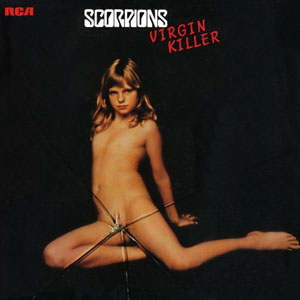
'Pictured Life', and 'Catch Your Train' are astounding, and Eddie Van Halen admits to the influence they had on his playing. 'Backstage Queen' showcases the decidedly more accessible direction that Klaus and Rudy were moving toward. 'Crying Days' and 'Yellow Raven' are pleasing down tempo, almost ethereal numbers, and Uli chimes in with three lead vocal numbers: 'Virgin Killer', 'Hell Cat', and 'Polar Nights'. The first two are manic, frightening numbers showcasing remarkable guitar skills and stupid regrettable lyrics. 'Polar Nights' finds Uli competing with Robin Trower for the Hendrix heir apparent crown, and would be a better song had he let Klaus sing it.
4) Taken By Force

This hard to find LP from 1977 was the follow up to 'Virgin Killer', and Ulrich Roth's swan song with the band. 'Steamrock Fever', 'We'll Burn the Sky', and 'He's a Woman - She's a Man' are featured on the much more well known live album 'Tokyo Tapes' recorded during the tour in support of 'Taken By Force', and 'The Sails of Charon' has benefited from it's inclusion on their first greatest hits package, 'The Best of the Scorpions'. If, then, you're thinking that you don't need this record, you are mistaken, because you need 'Riot of Your Time', and, if you buy the CD re-release you get the previously unreleased studio cut of 'Suspender Love', another killer 'Tokyo Tapes' track.
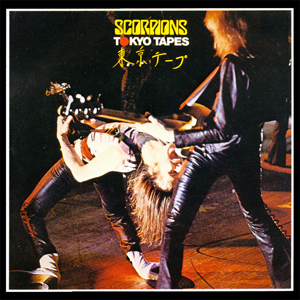
5) Blackout

Their breakout LP from 1982, 'Blackout' established the Scorpions in America with the hit 'No One Like You', a commendable commercial effort that stands up to the test of time. The title track continues the thematic formula of a narrative about sexual encounters gone wrong set to a massive riff.
What saves the LP, along with the hit song, and the solid Rocking displayed throughout, are the last two cuts, 'China White', and 'When the Smoke Is Going Down'. 'China White' is a super heavy down tempo number based on the 'less is more' ethos, and 'When the Smoke Is Going Down' is another beautiful ballad in a long line of such offerings.
6) Animal Magnetism

The title track is worth the price of purchase, simply wicked, it's Matthias' finest moment. Also included on the LP is 'The Zoo', which most people thought of as Matthias' finest moment until they read this post and were corrected in their thinking, which is not to suggest that 'The Zoo' is anything less than uber super duper. Who doesn't love Talk-Box?
'Hold Me Tight', 'Twentieth Century Man', 'Falling In Love', and 'Don't Make No Promises (Your Body Can't Keep) are notable tracks in the grand Scorpions Rocking tradition, the latter being the second installment of the sexual encounter gone bad series, and 'Lady Starlight' admirably fills the mandatory ballad spot on the record.
7) Love At First Sting

This is where I draw the line with the Scorps. The album is mostly formulaic drivel, 'Big City Nights' being a prime example of style over substance, a stratagem that dominates this gazillion selling package of eight turds and one gem.
8) Fly to the Rainbow

The Scorpions sophomore effort from 1974 is also Ulrich Roth's debut. In '74 Uli's freaky acid infused style was still fairly relevant, and his sole composition, and vocal, is the truly wonderful 'Drifting Sun'. 'Speedy's Coming' was the single, and it's a fun little number that references the Rock scene in '74, name checking Ringo, Bowie, and Alice Cooper. Jackson quite likes the title track, and finds the whole album enjoyable, but he also knows you prefer to be rocked like a hurricane. If there was one song as good as 'Still Loving You' on 'Fly to the Rainbow' this record would give 'Animal Magnetism' a run for it's money.
9) Lonesome Crow

10) Humanity: Hour 1

The most recent Scorpions offering (2007), 'Humanity: Hour 1' contains at least two great tracks: 'Humanity', and, you guessed it, 'Hour 1'. I don't own the record, but based on the performances of those songs at their recent visit to the Beacon Theater in NYC I'd have to place 'Humanity: Hour 1' above 'Savage Amusement', which has no good songs, and 'Crazy World', which contains the mediocre but timely composition and massive hit 'Winds of Change', and, I'm convinced without hearing any of it, nothing else of any worth.
Besides it's a Skorpionalben der Oberseite 10 list, so 10 it must be.
Monday, July 21, 2008

First some background. In the mid 60's a social sub-culture developed in the Haight Ashbury neighborhood of San Francisco. That scene died in the fall of 1967, but the bands that came out of that scene kept hippie culture alive. The pre-eminent band of that bunch was the Grateful Dead, and throughout the 70's, 80's, and early 90's a self contained society developed around the band, traveling to show after show. It had it's own economy based on the sale/barter of trinkets (hand crafted jewelery and pipes) and drugs.
In 1995 Jerry Garcia died, and with him, the Grateful Dead, but waiting in the wings to take the baton was Phish, a less blues based and more technically proficient band from Vermont. Phish inherited the fan base, the nomadic subculture, and built on it. Phish began putting on festivals that they not only headlined, but produced. They controlled everything.
Phish was a horrible band, and they eventually packed it in.
Now the Disco Biscuits, among other acts, are attempting to keep the Hippies alive.
Camp Bisco was a Disco Biscuits event.
I don't like them either, but tons of Hippies do.
Figo are not Hippies. We tried to wake them up a bit. We had fun. Figo played one of their best performances. The Hippies were afraid. Afraid of the Rocking. Silly Hippies.
Hippies have really dirty feet.
Wednesday, July 16, 2008

Tuesday, July 15, 2008

Much like the Stones, my brother Rod had exposed me to David Bowie long before I actually took much interest, and whereas Tony Alva was the impetus for my long overdue appreciation for the Stones, it was Milkyum who sat me down with 'The Rise and Fall of Ziggy Stardust and the Spiders From Mars' in 1984.
Although I accepted Ziggy, both the record and the man, as a work of genius, it sort of stopped there for a goodly amount of time.
Again, it was Milkyum who jolted me out of that rut in 1989 when he brought home the 'Sound and Vision' package. Much like everyone else, I was familiar with Bowie's initial and seemingly ubiquitous greatest hits package, 'ChangesOneBowie'. What I wasn't familiar with was anything else except 'Ziggy' and 'ChangesOneBowie'. 'Sound and Vision' fixed that. It was probably 'Panic In Detroit' that made me sit up and pay attention.
Still, however, I managed to remain only casually interested in Bowie. Having seen his 'Glass Spider' tour in '88, and having been extremely disappointed, I needed more convincing.
In '92 I set off to Albany for two years to finally put the last few nails in my undergraduate studies. In setting up my household I needed a CD player, so I went to Montgomery Ward to pick one up, and while I was there I spotted yet another Bowie compilation, the two disc set, 'The Singles Collection'.
That did it.
I was blown away by 'Life on Mars', 'Oh, You Pretty Things', 'Sorrow', and even acquired a fondness for post-Ziggy Bowie, which had always been the stumbling block for me. 'Be My Wife', 'Boys Keep Swinging', and 'Look Back In Anger' cured me of my issues, and paved the way for a classic Jackson style catalog acquisition. I bought all the Bowie I could find, but wisely stopping at 'Let's Dance'. There are certain absolutes in life, and Bowie between '83 and '93 is almost completely devoid of worth. 'Absolute Beginners' and some of the Tin Machine stuff are notable exceptions.
At any rate, I became a full fledged, card carrying Bowie freak.
In '96 I saw him live again, he played Roseland, and it was just after his co-headline tour with Nine Inch Nails. His band was shit hot, and although the techno/industrial vibe of his recent record, and the tour with NIN, was still prevalent, he played to please. He played songs that we wanted to hear. Still no 'Ziggy', but 'Moonage Daydream' was a very acceptable substitution. Oh yeah, the band, did I mention that they were shit hot? The reinstatement of piano player Mike Garson was a welcome comfort factor amid all the synthesizers and sequencers, but what really blew me away was his bass player, Gail Ann Dorsey, a tiny monster of a bass player, black, bald and barefoot, who took on the Freddy Mercury vocal parts for 'Under Pressure' and delivered the goods with considerable ability. Bowie's Tin Machine band-mate Reeves Gabrels handled the lead guitar spot, and though I'm not a huge fan of his hyper-electronic style, with all the squeals and wackiness, the songs were still the songs, and they were great songs.
Having redeemed himself for the crimes committed in the 80's, Bowie returned to making good records, even reuniting with producer Tony Visconti after many years for 2000's 'Heathen'.
I saw Bowie again in 2005 at Jone's Beach. He had kept much of the band I saw in '96, replacing Gabrels with another old pal, Earl Slick, a move I very much approved of.
The Thin White Duke had truly returned, and all was well.
Jackson's Best of Bowie Albums List:
1) Ziggy
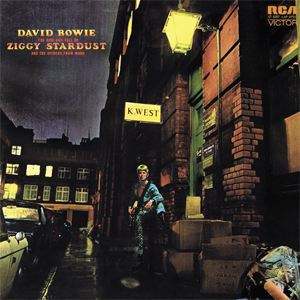
There's no argument here, again, there are certain absolutes.
2) Hunky Dory
If you listen close, you can hear Ziggy being born, it happens during the final moments of 'Life On Mars'. 'Changes' is the big tune, but I quite like 'Quicksand', 'Oh, You Pretty Things', and 'Queen Bitch'.
3) Let's Dance
With age comes clarity, and it's clear that 'Let's Dance' is nearly flawless despite it's commercial appeal. You already know the songs.
4) Aladdin Sane
Ziggy's last stand, and the last Ronson record, 'Aladdin Sane' contains my all time Bowie fave, 'Time', as well as a number of other standouts like, 'Drive In Saturday', 'Panic In Detroit', 'Cracked Actor', 'The Jean Genie', 'Watch That Man',and the title track. That's enough.
5) Diamond Dogs
On the strength of 'Sweet Thing'. It amazes me that it's David playing that sweet nasty guitar. 'Rebel Rebel' doesn't hurt it any, and the title track is a classic as well.
6) Scary Monsters
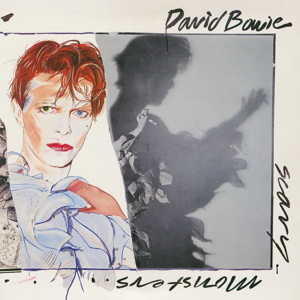
The bridge between Berlin era Bowie and the High Pop of 'Let's Dance' and after, 'Scary Monsters' finds David just where I like him, slightly weird, but accessible. Highlights include 'It's No Game', 'Up the Hill Backwards', 'Scary Monsters', and 'Ashes to Ashes'.
7) Station to Station
Many Bowie aficionados would rank 'Station to Station' much higher, but though I understand it's importance in his development, I just think that the songs aren't quite up to snuff. With the exception of 'Golden Years', and 'Wild Is the Wind', which is a cover, the other tunes are good, but not great. You won't find 'Station to Station' or 'TVC-15' in a current Bowie set list. The importance of those songs is the Kraftwerk influence, and Bowie's blend of that with R&B. The Krautrock fascination would take David, with Iggy in tow, to Berlin for his next series of influential, but decidedly un-commercial records.
8) Low/ 9) Heroes
1977's 'Low' and 'Heroes' finds David in Berlin with Brian Eno, racks of synths, and a rekindled ambition to make art. 'Low', and it's successor 'Heroes', are presented as two separate and distinct sides. Side One contains songs, Side Two consists of instrumentals. Although 'Heroes' is by far and away the best song from this period, 'Low' has a bit more to offer with 'Always Crashing In the Same Car', 'Sound and Vision', and 'Be My Wife'. Both records offer plenty of interesting soundscapes and creative production values, but in the end, David wasn't concerned with mass appeal, and it shows. That's why 'Scary Monsters' ranks higher than these oft touted influential offerings, it marries the art with accessibility. On 'Low' and 'Heroes' the audience is very much on the outside of the proceedings. David let's us in, a bit, starting with 'Lodger', the follow up to 'Heroes', even more so on 'Scary Monsters', and by 'Let's Dance' were all one big happy dancing family.
10) 'Lodger'
I had to think for a bit about this one. The other choice was 'Young Americans'. Again, most people would have probably ranked 'Young Americans' much higher, certainly above 'Lodger', but I just don't like 'Young Americans' very much. It sounds cold. It sounds like the absence of joy. 'Lodger', while no joyfest, has much more character, it has a sense of self lacking on 'Young Americans'. Sure the song 'Young Americans' is much better than anything on 'Lodger', but 'Lodger' has more depth with tracks like 'DJ', 'Look Back In Anger', and 'Boys Keep Swinging'.
Honorable Mention:
If David had combined the best bits of 'Outside' (95) and 'Earthling' (97), the result would be a formidable album that would have made the list. He didn't, and they don't.
Well, it seems there's another thing we all have to look forward to. David Bowie is releasing a live record recorded during the Ziggy Stardust (1972) tour in Santa Monica.

You can listen to it here, if you let VH1 install it's media player. I'll wait until I can hold the record in my hand and read the liner notes as I listen to what I'm sure is utter magic.
Read reviews here.
I'm quite sure this record will take the top slot on any 'Best Records of 2008' post of mine.
I'm also fairly sure it will be a cozy little list of two with this record and the Mudcrutch record.

Hmmmm, I guess House of Blondes makes three.

Hey, you never know, 'Chinese Democracy' might come out this year.
Pigs also might fly.

'Chinese Democracy', hee hee, just typing it makes me chuckle. Has any record ever had such a lengthy incubation? Has any record ever been so destined to be ant-climatic? Has any technically non-existent record ever had a wikipedia entry? I mean, even the title is so familiar now that it's become devoid of any power it might have had. If I was Axl, and I'm so very glad that I'm not, I'd come up with a new title.
It's just a joke at this point, and yes, I'm curious to hear it.

The first I ever heard of U2 was from Milkyum's then very hip uncle who mentioned them to us on a camping trip in Cape Cod in the fall of 1980. He told us that they were going to be the next big thing. We said; "Yeah, whatever, where's that Iron Maiden cassette?", and we promptly forgot all about U2.
A couple of years later, in the lunchroom at O'Neill, Milkyum, Billions, and I were commiserating about the usual stuff, chicks and music. Somebody mentioned that they had seen this band U2 on cable TV performing in concert, and it turned out that we all had tuned in. We all agreed that the band 'had something'. We all liked the captivating vocalist and his unique vocal style, how he let his voice crack impactfully, and we were puzzled and somewhat amazed by the guitar player who used echo as a rhythmic device, not just an effect.
It was clear, to me at least, that U2 demanded further investigation. I went out and bought their most recent release, 1983's 'War', and thus began an enduring love affair with this unique band of Irish upstarts.
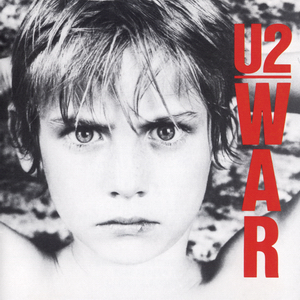
I listened to 'War' in heavy rotation during my senior year of high school, and by the time I showed up at the University of Maryland I had obtained their debut, 'Boy', and the mini LP of the concert we saw on cable, 'Under a Blood Red Sky'. At this point, U2 was just one of a number of bands that I was into, but during that first semester at the U of M two things happened that would propel U2 to the forefront of my musical attention. First I met Pat Coppinger who was a huge U2 fan, and then 'The Unforgettable Fire' came out.

'The Unforgettable Fire' remains my favorite U2 record despite the fact that it's not as strong of an album as both it's predecessor, 'War', and it's successor, 'The Joshua Tree'. The place in my heart occupied by 'The Unforgettable Fire' knows no reason, it's not constrained by any objective point of view. I know songs like 'Elvis Presley and America' and 'Indian Summer Sky' lack focus, and could be construed as unfinished, but I don't care, and I don't love them any less for it. At any rate, the stronger tunes, 'A Sort of Homecoming', 'The Unforgettable Fire', 'Pride', and 'Wire' totally take up the slack, and the little mini-songs, 'MLK', 'Promenade', and '4th of July' are sublime mood moments that, for me, make the record special.
And then there's 'Bad'. Had two chords ever delivered such majesty? Maybe, but I hadn't discovered the Velvet Underground yet. U2 had.
And the record sounded so fresh and new, and from a band that had already been fresh and new sounding. With 'The Unforgettable Fire' U2 embarked on a new direction in their approach to recording. Steve Lilliwhite, who had produced all the previous U2 records, was passed over for the production team of Brian Eno and Daniel Lanois. Eno was all about soundscapes, and Lanois was about songcraft and performance.
In addition to the change in personnel, they opted for a change of venue as well. They set up a studio in an old Irish castle, and immersed themselves in the process of making a record without the distractions of the big studio environment.
There was something to U2 beyond the radical sound, however, something that spoke to a part of me I hadn't been aware of, a social conscience. U2 woke me up to political struggle, as they did countless others not unlike myself, and they did it at a time when such a notion was all but dead in popular music.
Primed by a few months of immersion in the new record, U2 came to the Capitol Center. That show was the closest I've come to a truly religious experience. I was moved by an empathy more powerful than myself, it was a mass convergence, thousands of people beating with one heart, a singular experience that has never been repeated, not nearly.
That summer brought Live Aid, and U2 crowned themselves the greatest band in the world in fifteen minutes, the lion's share of which came in the form of one of the most impressive live performances ever. When the band began their second song, 'Bad', Bono decided to grab the brass ring, he went beyond, beyond the barriers, both the physical barriers separating the band from the crowd, and the less tangible barriers of what's expected from a band, and the ability to deliver a message. The message was hope, and everybody got it. They got it at Wembley, and they got it at home watching on television.
So, as a huge fan, I was eagerly anticipating the next record, and when 'The Joshua Tree' hit in 1986, I was greatly pleased. The problem was, as often happens, so were countless millions of others. 'The Joshua Tree' exploded, hurled U2 to the top, and rightly so, but when Rolling Stone labels you 'The Band of the Eighties', there will be repercussions.
It was evidenced in the girth and scope of 'Rattle and Hum', that the band had lost the plot, so to speak. Sure, they were still U2, they still sounded like U2, but something had changed. Was it expectation? Growth? I'm not sure, but the band I loved, the band with it's heart on it's sleeve and a distinct and unique sound had somehow gotten distilled.
U2 were Rock Stars.
Oh well, it was great while it lasted.
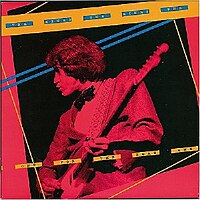
Glaring omissions, the pit fall of the list-maker. On my recent post about great live albums not only did I leave off 'Get Yer Ya Ya's Out', which Fred schooled me on, I also forgot this fantastic record by the Kinks from 1980.
Recorded during the American leg of their tour in support of the stellar 'Low Budget' LP, 'One For the Road' is jam packed with Kinks classics, many of which benefit from the heavier approach the band was working at the time.
Indeed, Dave Davies blasts his way throughout the four sides of this monster. At some point around this time Dave was asked in an interview if he was being influenced by the Heavy Metal bands of the day.
"It wasn't called Heavy Metal when I invented it."
Opening with an instrumental version of 'You Really Got Me', the band sets the mark for what will follow, blast after blast of high energy Rock occasionally peppered with more introspective numbers like 'Celluloid Heroes', and 'Misfits'.
Kinks staples include 'Til the End of the Day', 'Stop Your Sobbing', 'Where Have All the Good Times Gone', 'All Day and All of the Night', 'Victoria', and a rousing encore version of 'You Really Got Me' with vocals.
Much of the record is spent on the current LP release, 'Low Budget', including the title track, 'Catch Me Now I'm Falling', 'Attitude', 'Pressure', 'National Health', and '(Wish I Could Fly Like) Superman', and with good reason. That shit rocks.
The highlight is, of course, 'Lola'. A blistering rocked up take on the Kinks classic, the live 'Lola' was released as the single for the record, and it features the antagonistic charm and wit of bandleader Ray Davies. At the top of the track we hear Ray strum the instantly recognizable opening chord sequence and the audience naturally goes berserk at which point Ray stops. He then quips:
"Hey, I wasn't that good." And then after a pregnant pause:
"Because, uh, we're not going to play that one tonight."
Now the crowd fairly erupts, and Ray seemingly reluctantly gives in.
"Okay, but you've got to join in and sing along, I take a lot of persuading."
And then the band launches into the tune. That's called stagecraft, and Ray has it in spades.
In descending order:
3) The new season of Flight of the Conchords
2) Football
1) A different President

Monday, July 14, 2008

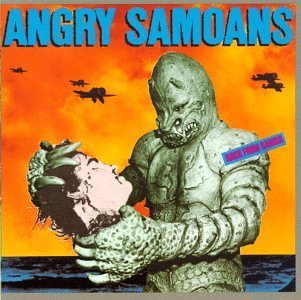
Recent activity on Mathdude's blog brought up the topic of Frank Zappa's 'Zoot Allures' LP. 'Zoot Allures' was one of the first Frank records that I heard. My brother Rod had it, as well as a number of others, and in my teenage years I developed an affinity for Frank based on that exposure. I'm sure what drew me to Zappa was his potty mouth, but it was the guitar tones on 'Zoot Allures', specifically on 'Wonderful Wino', that cemented the deal.
I remember I had a cassette tape of 'Zoot Allures' and some miscellaneous other Zappa tracks that I played a lot in 1980/81. I think one particular instance wherein I was playing that tape on my little boom box on the school bus was the point at which Tony Alva decided that maybe I wasn't an annoying little idiot.
I know for certain that in the summer of 1981, when Milkyum and I were councilors at West Point Youth Camp, I had brought along some Zappa, and before long my ten year-olds were walking around camp singing 'Bobby Brown Goes Down', a tale of accidental transgender and sado-masochism.
"Women's liberation came creeping all across the nation
I tell you people I was not ready, when I fucked this dyke by the name of Freddie
She made a little speech then, she tried to make me say when
She had my balls in a vice, but she left the dick
I guess its still hooked on, but now it shoots too quick"
I was told not to apply again the next year.
Personally I think Frank was a genius, and I find his music endlessly entertaining, but I've encountered a lot of opposition to Zappa over the years. People either love him, hate him, or have not been exposed to his work. Most of my attempts at turning folks on to Frank have not been very successful. Maybe that's because I'd always be hushing them so they didn't miss the next really funny lyric. That's very annoying, I know, but with Frank it's just so hard not to do.
Of those acquaintances who do like Zappa, many of them are stoic Mother of Invention fans, the first phase starting in the late 60's that featured a set line-up of musicians, the Mothers of Invention, and a decidedly vaudevillian approach centered around the live show, and a fair amount of improv within the context of Frank's compositions. I dig the Mothers, but I'm more fond of the post Mothers 70's stuff.
Jackson's Best of Zappa List:
1) Zoot Allures (1976)
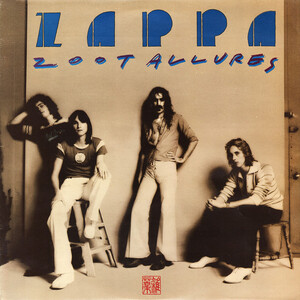
The whole album is great. 'The Torture Never Stops', 'Ms. Pinky', 'Wonderful Wino', 'Disco Boy', and 'Wind Up Working In a Gas Station' find Frank in top form and display a wide range of musical styles. The instrumentals: 'Black Napkins', 'Friendly Little Finger', and 'Zoot Allures' showcase his simply amazing guitar skills.
Many years after my introduction to this fantastic record I read in an interview with Frank that he cobbled the LP together from various out-takes and leftovers from previous records over the course of two days in order to supply Warner Bros with the final record of his contract with them.
I think that explains why I like the record so much, it's vary basic, mostly guitars, bass, and drums, and lacking in the xylophone and other extraneous instrumentation common to the Zappa canon.
2) Sheik Yerbouti (1979)
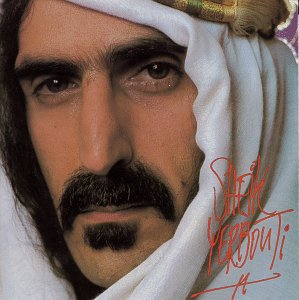
A double album, 'Sheik Yerbouti' is a lot to digest, and it can be overwhelming. Admittedly, I rarely ever listen to the whole thing in one sitting. The first side, however, is absolutely astounding. Beginning with Frank's severe mockage of Peter Frampton's turd of a follow-up to 'Frampton Comes Alive', 'I'm In You', 'I Have Been In You' establishes itself as a nicely crafted R&B number, and after suckering us in, he slowly pulls the curtain aside until you realize that he's very plainly discussing sexual penetration.
"I have been in you, baby, you have been in me
Aw little girl, there ain't no time to wash yer stinky hand
Go head and roll over, I'm going in you again"
Then he hits us with 'Flakes', with a special guest appearance by Bob Dylan (not really Bob), as he discusses his dissatisfaction with the job performance of various 'skilled laborers'. 'Flakes' also features a superb performance by guitarist Adrian Belew.
'Broken Hearts Are For Assholes' follows, and next to 'Bobby Brown' was a major factor in my not getting asked back to West Point Youth Camp'. The 'ram it up your poop shoot' bit is very catchy, and irresistible to ten year-olds.
The album also features the aforementioned 'Bobby Brown', the potentially very offensive 'Jewish Princess', and the single (single?) 'Baby Snakes' amid crazy instrumentals and other wacky Zappa compositions culminating in the sublime 'Yo Mama', which exhibits some mind-blowing Zappa lead guitar work.
3) Apostrophe (1974)

The Zappa record most often given spin time by my brother, 'Apostrophe' was most likely my first taste. Certainly 'Don't Eat the Yellow Snow/Nanook Rubs It' was an early favorite of mine. 'Apostrophe' finds Frank waxing allegorical, and much of the record takes the form of morality tales, twisted morality tales. 'Yellow Snow' pits a fur trapper against an Eskimo in a scatological battle over the fate of Nanook's (the Eskimo) favorite baby seal. 'St. Alfonso's Pancake Breakfast' details the delinquent behavior of a young parishioner gone amok of a Sunday morning. 'Cosmic Debris' finds the narrator forced to teach a lesson to a shady snake oil type street vendor, and 'Stinkfoot' provides a valuable lesson to those of us "who might wear tennis shoes or an occasional python boot".
It's 'Uncle Remus', however, that provides Frank's most stinging social criticism, and it might be the best example of what might be described as his better nature. A formidable Gospel evoking piano drives the track as Frank tackles racism, in particular Anglo Saxon prejudices toward African Americans. Initially, Frank takes the dangerous tack of what at first seems to be serious mockage of African Americans with his mention of afros and doo-rags, but we see, as the song concludes who's actually being mocked.
"I'll take a drive to Beverly Hills, just before dawn
An' knock the little jockeys off the rich people's lawns
An' before they get up, I'll be gone, I'll be gone
Before they get up I'll be knocking the jockeys off the lawn"
4) The Man From Utopia (1983)
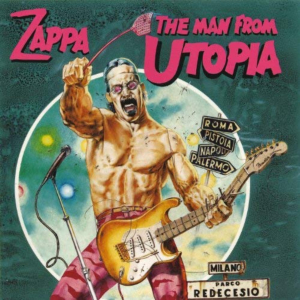
This mostly overlooked LP has been a favorite of mine since I bought it when it came out. Zappa's then protege Steve Vai is prominently featured on the record, as Frank's interest in playing guitar waned in the eighties.
'The Dangerous Kitchen', 'The Radio Is Broken', and 'Jazz Discharge Party Hats' are the highlights, but the whole record is strong, and is probably the last truly great Zappa effort as far as his work within the Rock idiom goes..
5) Over-Nite Sensation (1973)
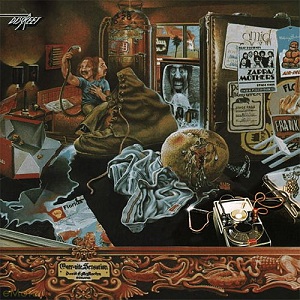
Sex is the main issue here, 'Camarillo Brillo', 'Dinah-Moe Hum', and 'Dirty Love' explore Frank's favorite topic. 'Montana' finds the narrator musing on the prospect of moving to Montana to raise a crop of dental floss.
6) Joe's Garage, Act 1 (1979)

The title track is one of the best things Frank ever did. Anyone who ever put together a band can relate.
"It wasn't very large
There was just enough room to cram the drums in the corner over by the dodge
It was a fifty-four with a mashed up door
And a cheesy little amp, with a sign on the front said Fender Champ
And a second hand guitar
It was a Stratocaster with a whammy bar"
'Catholic Girls' provides balance against 'Jewish Princess', and 'Crew Slut' and 'Why Does It Hurt When I Pee' deliver the crude sex based humor that is so prevalent in Zappa's music.
7) You Are What You Is (1981)

Another double album, and again, it's a bit overwhelming, but Side Three is very rewarding culminating with the exceptional 'The Meek Shall Inherit Nothing'.
"You say your life's a bum deal, and your up against the wall...
Well, people, you ain't even got no deal at all
'Cause what they do in Washington
They just takes care of NUMBER ONE
And NUMBER ONE ain't YOU
You ain't even NUMBER TWO"
There's much, much more Zappa, I've just scratched the surface, but these are my faves. Many of you don't care, and others will have a different list, and that's just dandy.
Saturday, July 12, 2008

In surprisingly prudent fashion, I have not read Rolling Stone in a good long time, but, as happens, somebody left a copy of the recent Obama cover issue at the studio. I walked in the door a couple of days ago, and right on top of the computer keyboard was the magazine, conspicuously opened to the Rush article. I wonder who would do that?
I read the Rush article. Same article it always is. Geek band, geek audience, still at it, the geeks inherit the earth.......blah, blah. When I finished the Rush article, I promptly put the magazine down. No need to get dumber by reading that crap. Today, however, as Chrispy was mixing a tune, I opened the damn rag again. I went to the letters from readers, which for some reason I usually find interesting. Well it seems that Rolling Stone had published a truly asinine feature in a previous issue; 100 Greatest Guitar Songs.
First off, what does fucking Rolling Stone know about guitar?
Second, I should never read this stuff. To that point, I was fortunate that I was only reading responses to the fiasco, not the fiasco itself.
The first letter was from Chuck Berry's son thanking Rolling Stone for ranking 'Johnny B. Goode' number one. Can't argue that really.
The second letter was from an apparently astute individual who questioned the viability of such a list in light of the fact the the name Joe Walsh appeared nowhere upon it.
There is intelligent life out there.
There was more grumbling from others whose favorite guitar players who got dissed. Without even reading the list I know I'd be hopping mad about both omissions and inclusions. Whatever. There's no way Schenker gets a nod.
Another reader was confounded by the total lack of female representation, and admittedly, my initial reaction was not outrage, as I wasn't sure any women deserved to make the list.
Then I thought about 'Barracuda'. I'd say 'Barracuda' should most definitely make a 100 Greatest Guitar Songs list. Then I thought about Joan Jett. Isn't 'I Love Rock and Roll' a great guitar song? I've spent over twenty-five years worshipping that guitar tone, and the solo section? Damn, that shit is miles beyond anything Clapton ever came up with.
Early Benetar has some great guitar moments, but I don't think any of it makes the cut. I'd leave Lita off as well. Certainly no Vixen. What else is there? Am I leaving someone out?
Top three outfits featured by male performers in the movie 'The Last Waltz':
The women are excluded because, well, they're chicks; they live for clothes. If I did include them, I'd have a tough time choosing between Staples Singers. For the record, I don't remember what Emmy Lou was wearing; she's so stunning and talented that silly things like clothing fade way into the background. Joni looks like a coat hanger, literally.

1) Muddy Waters. A fact's a fact.
2) Van Morrison. Purple satin pants and matching shirt with the widest lapels in recorded history.
3) Neil Diamond. The shades, massive amber lenses. I think he borrowed them from Streisand.
Dr. John's scarf gets an honorable mention.
Top Three Batmen:

1) Adam West
2) Christian Bale
3) Val Kilmer
Top Three Bowie Guitarists:

1) Mick Ronson
2) Earl Slick
3) Carlos Alomar
Honorable mention to Stevie Ray, who is most excellent, but I can't really label him a 'Bowie Guitarist' for one album and no tour.
Top Three Modern Animated TV Shows:
Modern means within the last twenty years in this case.

1) The Simpsons
2) South Park
3) The Robert Smigel SNL stuff (Ambiguously Gay Duo, Fun With Audio, TV Funhouse...)
All you Family Guy freaks hush yourselves.
Friday, July 11, 2008
Over the years, Milkyum, AKA Mr. L. Smart, has been responsible for introducing me to much of what I consider to be my favorite bands/acts. He gave me Bowie, T-Rex, the Sex Pistols, Jane's Addiction, and the Dogs D'Amour to name a few. Sorry dude, Dokken never grabbed me.
Sure, eventually I would have undoubtedly found those artists, with the exception of the Dogs D'Amour. I don't think they'd have crossed my transom had he not brought home 'In the Dynamite Jet Saloon' in 1989 when we shared a tiny house in West Nyack.
A British Black Crowes with penchant for whiskey instead of cannabis, a slightly shambolic Stones meets Punk vibe much like Hanoi Rocks or New York Dolls/Heartbreakers/Johnny Thunders type sleaze Rock with some actual competence tossed in for shits and giggles? I'm not sure exactly, except that I dug them Immediately.
Led by the dentally impaired, mono monikered Tyla (vocals, rhythm guitar), the Dogs deliver the goods on 'In the Dynamite Jet Saloon'. Bluesy barroom guitar Rock with booze shattered vocals that describe a life dedicated to inebriation in a lyrical style reminiscent of T-Rex and Thin Lizzy (Marc Bolan and Phil Lynott), 'In the Dynamite Jet Saloon' was straight up Jackson's alley.
A lyric from the opening track, 'Debauchery', says it all:
"When the Devil comes down to get you
Your place is such a mess"
'I Don't Want You To Go', and 'How Come It Never Rains' are fully competent Pop tunes that any band would be glad to have written. Anthems like 'Wait 'til I'm Dead' and 'Last Bandit' litter this just about flawless record, and 'Billy Two Rivers' showcases the bands ability to dial back the bombast in favor of an acoustic driven sound that comes off as comfy territory for a band that simply could not have been as drunk as advertised.
'King of Thieves' ('Errol Flynn' in the UK) followed '....Dynamite Jet Saloon', and Mr. L Smart wasn't that keen on it. Granted is wasn't as strong as it's predecessor, but it does have some great moments. 'Drunk Like Me', 'Trail of Tears', and 'Ballad of Jack' are great tracks, but much of the record comes off as re-treads of 'Dynamite Jet Saloon', much like the second New York Dolls record in relation to the first.
The Dogs - Tyla and a revolving door line-up, have kept working, and released a record as recent as 2005, but the golden age of '....Dynamite Jet Saloon' remains the band's peak.
Jackson digs himself some Dogs D'Amour. Mayhap you would too.
My first memory of Cheap Trick was a photo of Charlie Huhn from Ted Nugent's band wearing a Cheap Trick tour shirt in '78. Then 'At Budokan' hit, and Cheap Trick was suddenly huge. Certainly name checking Kiss on 'Surrender' was a major factor in grabbing my attention.
For years all I had was 'Budokan' and 'Dream Police', the studio LP that followed 'Budokan'. I figured that 'Budokan' had all their good songs up to that point, no need to buy the studio albums, besides, I had heard the studio cuts of 'Surrender' and 'I Want You To Want Me', and found them lacking in comparison.
I was wrong, of course, but it took until the re-release of 'Budokan' in 1998 for me to realise exactly how wrong I had been.
In my record collecting over the years, I had picked up the first three Cheap Trick albums, the self titled debut, 'In Color', and 'Heaven Tonight', but with the exception of 'Ello Kiddies' off the first record, I never listened to the records, I simply needed them for the collection.
Then my room-mate Kory gave me the re-release of 'Budokan', which had a second disc with all the songs that didn't make the first edition. Holy Lost Treasure of the Sierra Madre! There was some great stuff there, songs I'd never heard, songs that knocked my stinky socks off.
I immediately went and dug out those first three albums, and I found that all the songs that had bowled me over on the new 'Budokan' disc were from 'In Color'.

What a great record!
The songs from 'In Color' that appeared on the initial release of 'Budokan' are 'Clock Strikes Ten', 'Hello There', and 'I Want You To Want Me'. As previously mentioned, I much prefer the live version of the latter. The studio version attempts a decidedly un-Rock approach that fails in my opinion, but the other two feature the same arrangement and feel that they brought to Japan for the recording of the live record, a Big Rock feel.
The big 'a-ha' moments, however, are 'Big Eyes', 'Downed', 'Oh, Caroline', and 'Southern Girls'. How did I miss these stellar tracks!
'Downed' is easily a better song than any other Cheap Trick tune, other than 'Surrender' or 'Dream Police'. Rick Nielsen gives us a peek on 'Downed' at the more complex type of composition he'd spend much of the 'Dream Police' record working up, but it never gets cumbersome as it does at times down the road.
'Big Eyes' is simply another great Hard Pop tune that would have made a great single instead of the light version of 'I Want You To Want Me'.
'Oh, Caroline' is an example of the classic Cheap Trick style, a slightly quirky arrangement that makes the tune feel different from the standard Rock fare of that era, but with the familiar tones and vibe that you'd expect from a late '70's Hard Rock act.
That's what's special about Cheap Trick, they had an approach that was fresh but well worn at the same time. One foot in the '80's with the other hanging out with Nugent and ZZ Top of the '70's.
'Southern Girls' presages the High Pop of late '80's 'The Flame' era of Cheap Trick but without the over-production and gloss that took the fun out of the band.
'You're All Talk' is another highlight featuring the under-used angry Robin Zander vocal style ('Gonna Raise Hell', 'Cold Turkey').
Jackson implores you to purchase 'In Color' immediately.
After 'Dream Police', Cheap Trick had both feet squarely in the '80's and they lost some zeal, and consequently appeal. They resurfaced in the mid 90's with some gusto in the form of two cover tunes. On their Greatest Hits package they included a wicked version of the Beatles 'Magical Mystery Tour', and true disciples that they are, they delivered an astounding treatment of 'Cold Turkey' on the Lennon tribute record. The original, when it came out in '69, dumbfounded Beatles fans with it's sheer painful vibe. Heroin withdrawal is a horrific experience, and John sought to represent it as honestly as he could. Cheap Trick manages to kick it up a notch. That track alone is well worth the purchase of the disc.
Tony Alva and I saw them a year ago opening for Alice Cooper. They received the sound shaft that opening acts tend to get. I couldn't believe that Cheap Trick was given such shoddy treatment, but bad sound or not it was clear that they still loved to play, and that Zander's voice is still 50 times larger than he is. He has such power, and he looks like a fucking Nelson twin, truly puzzling.
Thursday, July 10, 2008

Also known as 'Compact Disc', and 'Cassette', Public Image Ltd. released 'Album' in 1985 and confused the hell out of people.
PIL co-founder Keith Levene had departed in 1983, his drug habit having disabled his ability to perform, leaving John 'Rotten' Lydon holding the bag so to speak. The lack luster (lustre) 'This Is What You Want.....' followed in 1984, and it was clear that Lydon needed some help getting on with it without Levene, who had provided the soundscapes over which Lydon spat his vitriol.
In stepped producer Bill Laswell who took over as musical director and supplied Lydon with a band for the recording of 'Album'. That band, the un-likeliest band for a Johnny Rotten project, consisted of Steve Vai, Ryuichi Sakamoto, and Ginger Baker.
As one would suppose, given the personalities involved, the album was unlike previous PIL records; it was unlike any previous records. I mean, wasn't Ginger Baker dead?
Well, dead or not, Ginger managed to leave Laswell and Lydon an album's worth of solid pounding drums. Laswell gives Ginger's performance the big 80's drum treatment, but with a lot of room that sounds like a room and not a reverb.
And Steve Vai? Wasn't he the enemy? Apparently not. For all of Vai's considerable ability to shred, for all of his stunning flash displayed on any other record he appears on, it is his unselfish song-serving lack of profile playing that he puts in on 'Album' that earns him copious amounts of respect. Sure, he tosses in some speedy arpeggios during the fade-outs on a few cuts, but he gives John the spotlight throughout the record, as he should have. Maybe Laswell had to dial him back a bit, but I like to think Steve just knew what the gig was, and did the job he was hired to do. It must have been refreshing for him.
The hit was 'Rise', John's take on the old Irish blessing; 'May the road rise to meet you'. Lyrically 'Rise' is typical Lydon rhetoric, keeping things well ambiguous. He could be wrong, he could be right. You just can't nail John down.
'Rise' aside, with it's chimey guitars and melodic treatments, the whole album fairly stomps along with bashing relentless rhythms as established by the opening track, 'FFF', which seethes appropriately, but I think 'Fishing', the third cut, is the stand-out number. It contains my favorite post-Pistols Lydon moment. Taking a page from the Streisand canon and snidely turning it on it's ear, he quips: "People who need people are the stupidest of people".
Truly 'anger is an energy', and John has never lacked for energy, but it was Bill Laswell on 'Album' who managed to focus the anger/energy, and deliver a consistent PIL record, a serious PIL record.
Wednesday, July 09, 2008

Forgive the belated nature of this post, I meant to get to it sooner.
So, 4th of July in New York City, the place to be, right? You'd think Philly would be the big spot on the 4th, but, well, as in all things, Philly is kind of a second rate NYC, isn't it? Hell, they probably would have had the Continental Congress in New York back then had it not been filled with dirty Loyalist bastards and closet anglophiles like Alexander Hamilton. They say Philly was chosen because it was sort of equidistant between the pompous New Englanders and the also pompous Carolinains. Sounds like a cover story, more likely they couldn't afford the rents in NYC.
At any rate, the Legal Diva and I manged to get out of the house and over to the Brewery, the mammoth structure - in fact an actual Victorian age brewery, that houses the new Smoke and Mirrors to view the fireworks. Smoke and Mirrors actually offers a great view of Manhattan, but we decided to join the party up on the roof for a completely unfettered view of the proceedings. The light rain was easily tolerated as Chrispy, Annie, the Legal Diva and I took in the spectacle. The fireworks guys that Macy's hires never fail to deliver a superb display in celebration of our nation's birth.
Later that weekend the Legal Diva and I managed a trip to the Metropolitan Museum of Art, dinner at the Heidelberg, and a lovely trip to the South Street Seaport with the Drunken Fool and his always engaging better half, Leslie. We drank huge beers in styrofoam cups at Jeremy's Ale House, sampled some fried seafood, and took a gander at the Waterfalls, a giant installation art piece currently on display in the Eat River that features four 'waterfalls' at various points on the river around lower Manhattan. It's fairly cool, specially at night.
It was a nice holiday weekend, hope yours was too.
I posted recently about a local cache of vinyl that I've been mining, and while I mentioned the more notable records that I purchased, there were some other more obscure gems that I picked up as well.
As discussed in another recent post, after Ian Hunter left Mott the Hoople with Mick Ronson in tow, the band attempted to continue on as Mott (no Hoople) without him without much success. By 1977 Mott was over, but drummer Dale 'Buffin' Griffin and bassist Overend Watts formed a new band, British Lions, and released this self titled LP.

It's actually pretty good. It bears no real sonic likeness to Mott the Hoople, but the record delivers above average Hard Rock of the late 70's British variety. I found no real fault with anything I heard, except that it was, well, un-exceptional. Nothing to shout about, but a worthy addition to the vinyl library especially given it's Mott the Hoople connection.
Back in the late early 80's, or the early mid 80's, finding a new Hard Rock/Heavy Metal band was a mark of distinction amongst our crew. I'm not sure who first came home with the Talas record - 'Sink Your Teeth Into That', but for a brief time it got some recognition. Talas was a Buffalo based band that played the Mid-Hudson circuit, and when their record came out, a number of us bought it.

Neither back then, nor now, is there any need for an 'Eddie Van Halen of the Bass'. Talas, led by bassist Billy Sheehan featured not only a bass heavy mix, but completely unnecessary , over the top, self indulgent lead bass playing. It's just not natural. There's even an 'Eruption' like bass solo track complete with finger tapping and dive bombs.
Billy's overplaying got him noticed in athletic rock circles and unsurprisingly showed up in David Lee Roth's post Van Halen band. Diamond Dave even included the Talas song 'Shy Boy' from 'Sink Your Teeth Into That' on his 'Eat 'Em and Smile' LP. It's notable that Billy's bass parts were sufficiently tamed within the Roth camp, as well as his next venture, the wholly mis-named Mr. Big. In my research I found that Billy is a Scientologist which is somewhat telling in retrospect.
'Sink Your Teeth Into That' might have been a decent record had somebody had the balls to tell Billy that lead bass is stupid, and he should stick to supporting the groove with the drummer, but nobody did, and the album is only noteworthy for it's nostalgic qualities, as well as serving as an example of what not to do with a bass guitar.

I was pleasantly surprised, however, by Riot's 'Rock City' album. Without a doubt, Riot's best offering came with the addition of vocalist Rhett Forrester on the 'Restless Breed' LP in '82, but the band had been together since '75, and 'Rock City', their debut ('77) is a strong record. I had always chalked up pre-Forrester Riot as second rate, a notion based on my purchase of their second release, '79's 'Narita', which failed to knock my socks of back in the early eighties, but a good showing on the Castle Donnington 'Monsters of Rock' live record from the 1980 Donnington Festival in the form of the tune 'Road Racing' prompted another look into this Brooklyn based Hard Rock act.
Much like the British Lions record, 'Rock City' is an above average example of pre-shred age Hard Rock, and looking back, it's much better than much of the crap that I was into at the time.
Tuesday, July 08, 2008

There are six distinct stages to Alice Cooper's recording career. The 3rd phase, the initial solo years - the Hollywood Vampires age, lasted from 1975 to 1979, and 'Goes to Hell', the second solo effort from 1976 is my favorite. Most folks would put up the first one, 'Welcome To My Nightmare', but for my money, 'Goes To Hell' is the record.
Featuring a who's who of A-list session players as well as the usual suspects in the guitar department - Steve Hunter, Dick Wagner, 'Goes To Hell' is a bounty of astounding performances deftly assembled by Bob Ezrin on his 7th consecutive Alice Cooper record.
Whereas 'Welcome To My Nightmare' tries to offer an overall concept - a nightmare, with the songs tying together under a very broad banner, 'Goes To Hell' is much more realised in concept, thru-line, and narrative. Basically, Alice (Steven) is condemned to hell for all the horrible things he's done, and after failing to convince the Devil to let him go, he settles in.
'Go To Hell' kicks it off with a stellar bass line courtesy of Tony Levin. Alice tells of 'Criminal acts and violence upon the stage', for which he 'can go to hell'.
The confounding 'You Gotta Dance' comes next. I used to lift the needle here and skip this one, but in recent years I've come to appreciate the groove and how well it's played. I suppose doing a disco type thing was damning enough for inclusion on the record.
The theme kicks back into gear on the third track, 'I'm the Coolest'. A sultry slow and very smoky jazz feel accompanies Alice as the Devil boasting about his superlative coolness.
'Didn't We Meet' follows, and it's simply majestic. This is the Apex of the Cooper/Ezrin collaboration. Absolutely charming, absolutely wicked.
"Pardon me, but you see, I've seen that face before
I know those eyes, unearthly wise, I feel it more and more
To look at you, Deja Vu, chills me to the core
They say that you are the king of this whole damn thing
But that only confused me
They say I don't stand a ghost of a chance with my host
And it frankly amused me
So let's drink a few
Here's looking at you, I'd swear
Didn't we meet in the night in my sleep somewhere
Didn't we meet in the night in my sleep somewhere"
Side One wraps with the single 'I Never Cry', a touching ballad about loneliness and alcoholism which was a solid radio hit in 1976, and continues the trend of a ballad single started by 'Only Women Bleed' on the previous record ('Welcome to My Nightmare'), and is followed by 'You And Me', and 'How You Gonna See Me Now' on the two ensuing LPs ('Lace and Whiskey', and 'From the Inside' respectively).
'Give the Kid a Break' opens Side Two with a big production number featuring Alice being judged and sentenced by the Devil. Stage ready, Alice and Ezrin expand on Alice's love of theater on this tune.
Alice then accepts his fate, and waxes unapologetic on the good old Rocker 'Guilty' which showcases some outstanding lead guitar, and classic Alice bad boy lyrics.
"Just tried to have fun
Raised Hell and then some
I'm a dirt talking , beer drinking woman chasing minister's son
Slap on the make-up
Blast out the music
Wake up the neighbors with a roar like a teenage heavy metal elephant gun
If you call that guilty, then that's what I am
I'm guilty, I'm guilty"
'Wake Me Gently' brings it down again. Here we find Alice pleading for the rescue that won't be happening, and though it's well done, it's a bit weepy.
'Wish You Were Here' picks it back up again with more stellar guitar, a great groove, and a witty lyric about letters home from hell. Hunter and Wagner outdo themselves on this lost Alice track.
"I sent a postcard, thought it would be funny
I would have sent a souvenir, but they took all my money
It's pretty warm down here, but it ain't sunny
And I'm having a Hell of a time, my dear
Wish you were here
I tried to phone you, tried to call you
Long distance operators; they only stall you
Besides the damn rates are so high, they'd just appall you
And I'm having a Hell of time, my dear
Wish you were here
It started out on a nice vacation, left the station right on time
Now it's turned to pure frustration, I'm just a prisoner in time
Can't get a ticket to get me home dear
They just don't have too many flights from twilight zone dear
And I'm having a Hell of time, my dear
Wish you were here"
'I'm Always Chasing Rainbows', and 'Going Home' wrap up the LP in grand Ezrin pomp and circumstance style, but again, they don't quite stand out against the Rocking of previous tunes. That's the problem with concept albums, the need to reconcile the story line. It often makes for some questionable material.
All in all, though, 'Alice Cooper Goes to Hell' makes for some excellent listening, and it's Jackson recommended.
Friday, July 04, 2008
Without a doubt I'm a Jackson Come Lately. I didn't 'get' the Stones until 1984, and at one point during my Metal years I told my brother Rod that Keith was a shitty guitar player. Clearly I hadn't 'gotten' it yet. Well I came around, and when I did, I devoured their catalog with the customary Jackson zeal. I've studied the Stones exhaustively, and this is a summation of those 23 years of discovery.
1) 'Exile On Main Street'

No big surprise here. 'Exile' contains the whole package: Blues, Country, Gospel, Rock and Roll, attitude, and genuine proficiency in their craft. Everyone said it was the definitive Stones record, and so I bought early on in my mad dash to obtain the entire catalog, a process that took about a year and a half on my meager college student income. Initially I took to the big Rock numbers - 'Happy', 'Tumblin' Dice', 'Rocks Off', but the lure of 'Sweet Virginia' was irresistible, and soon I had to admit that I enjoyed Country Music. That was a hard pill to swallow, but not that hard. The Stones softened the blow with their absolute coolness. Over time, however, it has become clear that the standout tracks are the Gospel numbers: 'Loving Cup', 'Shine a Light', and 'Let It Loose'. When I get down on Mick, as I do when I am confronted with the high cheese factor that is always lurking very close to the surface with him (see 'Dancing in the Street' duet with Bowie), I turn to these songs to remind me of his considerable talent. When he wants to Mick can sell shit to a shit salesman.
2) 'Sticky Fingers'

Tough call, but 'Sticky Fingers' gets the nod. Again the Rockers lure you in. 'Bitch' and 'Brown Sugar' alone would be sufficient for most any band, but the Stones keep you Rocking throughout with well placed high energy numbers like the ever so under rated majesty of 'Sway', and the monster riff of 'Can't You Hear Me Knocking'. 'Dead Flowers' began the conversion that 'Sweet Virgina' completed, while 'Ive Got the Blues and 'You Got To Move' proved beyond any doubt that of all the Blues enthusiasts that comprised the British Invasion bands, The Stones were the only band to actually play, no less write, a proper sounding Blues track.
3) 'Let It Bleed'

The transition from the singles oriented Pop band of the mid 60's to the 'World's Greatest Rock and Roll Band' happened over the course of two records, three if you count the 'Jumping Jack Flash' single, but it was 'Let It Bleed' that cemented the process. Is there a better song than 'Gimme Shelter'? Could there be? The inclusion of a Country version of their current single, 'Country Honk', is a master stroke. 'Midnight Rambler' is the very delineation of the border between Blues and Rock, which is why it makes you want to fuck. 'You Got the Silver' marks the debut of the 'Keith Tune', and quite possibly is the best of that lot. The quality of Keith's voice is so empathetic, so completely honest and earnest, that he can just about say anything, as he often has. One of the truly greatest composition that Mick and Keith have ever unleashed is also one of the most unusual, certainly as far as the chord structure is concerned, 'Monkey Man' is one kooky cookie, but man does it cook. I never cared for 'Live With Me' very much, but a lot of people like, so, uh, there's that.
4) 'Beggar's Banquet'

Seems were just travelling back in time from 'Exile', right? Well, that's how it went down, don't blame me, I didn't make these records. As if. At any rate 'Beggar's Banquet' was a drastic change of direction for The Stones. Gone was the wearing of the psychedelia, the clearly un-heartfelt bandwagonning of 'Satanic Majesty's Request'. Gone was the assortment of quirky non-Rock musical Instruments of 'Between the Buttons'. Gone was Andrew Loog Oldham. To replace all that, The Stones simply got back to making the music that they became the Rolling Stones to play, Blues. 'No Expectations', 'Dear Doctor', 'Parachute Woman', and 'Prodigal Son' are all pure Blues, and 'Stray Cat Blues' begins the process completed by 'Midnight Rambler'. Somewhere between 'Satanic Majesty's Request' and 'Beggar's Banquet' the acid wore off, Keith found open tunings, and he dusted off his acoustic guitars, which are prominently featured on the record. 'Sympathy for the Devil', and 'Street Fighting Man' keep the record selling, and 'Slat of the Earth' keeps Jackson spinning it.
5) 'Some Girls'

Keith emerged from heroin with a yen for a good Rocking. Despite the amazingly competent Disco feel of the big hit, 'Miss You', the album is loaded with Rock. A Country tune, 'Far Away Eyes' shows up featuring a somewhat cartoonish delivery by Mick. Keith delivers 'Before They Make Me Run', his farewell to dope, and a semi-regular feature - a Motown cover, in the form of 'Imagination' certainly hits the mark, but the standout track, 'Miss You' aside, is 'Beast of Burden'. 'Shattered' is always fun, as is the title track, while 'When the Whip Comes Down', 'Lies', and 'Respectable' provide the raw Rocking that was so refreshing in '78.
6) 'Goat's Head Soup'

Two of my favorite Stones tunes are on 'Goat's Head Soup', coincidentally they are also two of Mick's finer moments, '100 Years Ago', and 'Winter'. Keith gives us the splendid mood setting 'Coming Down Again', and 'Heartbreaker (Do Do Do Do)' is the home to one of the coolest riffs in Rockdom. The good old Crudest Rock and Roll band in the World drop in for 'Star Star', wherein the 'F' Bomb is prominently featured in the hook. Blah blah blah 'Angie', blah blah.
7) 'Black and Blue'

What makes 'Black and Blue' a better record than 'Aftermath', 'Tattoo You', or 'It's Only Rock and Roll'? Three words: 'Hand of Doom', easily the most smoking Stones tune. 'Memory Motel' is astounding with both Mick and Keith delivering impressive vocal performances. The Legal Diva likes 'Melody' which features Billy Preston on keys and vocals. I love the Caribbo-Funk of 'Hey Negrita' which finds the Stones mixing musical metaphors, and once again flirting with racial taboo. 'Cherry Oh Baby' marks the first successful attempt at Reggae and features a noteworthy backing vocal by Keith.
8) 'Tattoo You'

I'm sure some will grumble. I've never understood the lack of respect this album draws. 'Start Me Up'? 'Waiting On a Friend'? 'Little T&A'? Hell, that should be enough, but wait, there's more! Without a doubt, 'Worried About You' is my favorite song on 'Tattoo You', and one of my favorites over all. A simple wonderful groove. 'Slave' is another great groove, though it does lack serious lyrical content, but then again, the groove is immaculate. 'Hang Fire' is a fun little number with a great lyric:
"In the sweet old country where I come from
Nobody ever works, and nothing gets done
Hang fire, hang fire
You know marrying money is a full time job
I don't need the aggravation, I'm a lazy slob
Hang fire, hang fire
Hang fire, put it on the wire, baby"
9) 'It's Only Rock and Roll'

A sturdy but not overly great record, 'It's Only Rock and Roll' has it's share of gems. The title track is, of course, a classic, and deservedly so. 'Ain't Too Proud to Beg' is probably their best Motown cover. 'If You Can't Rock Me' delivers the Rock, and 'Luxury' is a pleasing if somewhat failed first stab at reggae. Billy Preston makes his first featured appearance on 'If You Really Want to Be My Friend' which rollicks and frolics loosely about but somehow manages to endear. I've always had a soft spot for 'Short and Curlies', an old school Ian Stewart piano driven Rock and Roll number, and 'Fingerprint File' is certainly amusing.
10) 'Out of Their Heads'

Based on my criteria, number of standout tracks and their respective quality comparatively, 'Out of Their Heads' rounds out the list. 'The Last Time', '(I Can't Get No) Satisfaction', and 'Play With Fire' were the hits. 'The Spider and the Fly' is also noteworthy. At this point, in early 1966, the Stones were still relying heavily on covers; a total of five appear on 'Out of Their Heads', but regardless of publishing rights, it's still a stronger record than any of the remaining releases.
Okay, now let the rebuttal begin.
Thursday, July 03, 2008
When I met Hazmat back in 1989 we began a reciprocating musical education relationship that continues to this day. I gave him Uriah Heep, and he gave me Bauhaus. The mutual edification did not end with those bands, but they sum up the basis of the deal. I turned him on to lost 70's Rock bands, and he turned me on to seminal Punk and Post-Punk bands.
![]()
Of all the assorted and sundry acts that Hazmat turned my attention to, Bauhaus is my favorite. I had heard their cover of 'Ziggy Stardust' back in 1984 when a friend at the University of Maryland let me make a mix tape of some of his records. The tape included The Damned's cover of 'White Rabbit', and the Dead Kennedy's 'Too Drunk to Fuck' among other forgotten tunes, but the Bauhaus had struck a chord in me. Their version of 'Ziggy' retained all the urgency and Englishness of Bowie while taking the power up a notch. Bauhaus' 'Ziggy' fairly slams, it's almost Metal. With that notion in mind, I was keen on Hazmat's suggestion that I pick up a copy of Bauhaus' 'The Sky's Gone Out'.
Bauhaus was decidedly not Metal.
That was okay though because the album rocked well enough.
Opening with a cover of Eno's 'Third Uncle', Bauhaus displayed a heaviness that pleased. A driving thumper of a bass line delivered by David J propels the tune at a rapid pace while Daniel Ash provides the edgy echo laden guitar histrionics that are a staple of the Bauhaus sound. Kevin Haskins' steady and sympathetic drums complete the galloping sound scape over which Peter Murphy channels a madness infused Bowie vocal style.
To call Murphy a Bowie clone does a disservice to both of them, but the comparison is unavoidable. Peter has more insanity in his delivery, almost like the sick offspring of Iggy and Bowie.
'The Silent Hedges' finds the band in more ethereal territory with chimey guitars and sparse kick and snare drums. Then the fuzz bass kicks in and brings the tune toward frenzy, going to hell again......again, again.
'In the Night' is next, and it's clunky off time rhythm creates another musical space on this very dynamic record, but it's the fourth track, 'Swing the Heartache' that truly delivers what could be deemed the classic Bauhaus sound: simple drum patterns twisted with processing coupled with thumping sedentary bass under mad echo guitar noises that suddenly switch to searing melodies briefly before returning to chaos while Murphy emphatically demands the incomprehensible from us.
It's big stuff. Heady stuff. Art.
Side One ends with 'Spirit', and while I know it's a favorite of Hazmat's (actually, I think he prefers the single version over the LP track), I'm not a huge fan of the tune. To me it's an obvious attempt at accessibility and commercial success with it's pandering hook; "We love our audience, we love our audience,....."
Flipping the record brings a total mood alteration. 'The Three Shadows' (Parts 1, 2, and 3) is down tempo and sparse with the drums, piano, and guitar blended, washed with reverb, and buried in the mix on top of which Peter Murphy waxes poetic, a poetry Guy de Maupassant might have inspired. Part 3 picks up in tempo, and weirdness with crazy tuned acoustic guitars and treated piano. Murphy rises to the occasion.
'All We Ever Wanted Was Everything' follows and briefly brings us back to some sense of normalcy with it's layered acoustic guitars and chanting vocal melody, but it quickly passes and in it's place come 'Exquisite Corpse' which continues the general wackiness. Instruments come and go, sometimes dropping out altogether while Murphy informs us that 'life is but a dream'. Well, 'Exquisite Corpse' is one fucking loon of a dream. Suddenly the band falls in with a beautiful arrangement, but don't get too comfortable because soon it turns dark as Ash starts talking about something equally incomprehensible heralding Murphy's desperate screaming 'the sky's gone out', then it all stops, a quick Caribbean feel falls in which quickly degenerates into more madness until finally the sky does go out.
Bauhaus is not for everyone, not then, and not now, but for the adventurous listener, someone who enjoys creative and inventive production values, Bauhaus is a must.
In 1977 I was emerging from a year of compulsory study in modern music, Rock 101, an entry level course in rudiments - The Beatles. My brother Rod had bought me 'Abbey Road' the year before, and I quickly obtained much of their catalog. My concentration in that field of study was the latter half, '66-'70. I liked the heavier, freakier stuff, and so it was only natural that at the end of that year, when I was ready to absorb the greater world of popular music, I tended toward the heavier, freakier stuff: Kiss, Aerosmith, Ted Nugent, and Van Halen. Those were the big bands of the day, and a huge part of the foundation of my musical sensibilities.
In '78 Nugent and Aerosmith were the top grossing acts on tour, Kiss had set box office records the year before, and Van Halen were opening up for one of them most of the time . Although posterity observes that each of those three headlining acts were in fact past their peak in 1978, it wasn't that clear yet since 1976 represents their respective/collective peak year.
30 years is a good stretch of time, and it's notable that there is any relevance attached to these acts today, but for what?

'Double Live Gonzo' is still one of the greatest live records ever made, and Ted's influence as a Guitar God is undeniable, but today he is more well known for his hunting, reality TV, and his extreme right wing political views. Ted recently left Michigan (very Rock) and moved to Crawford, Texas (very not).

In 1978 Kiss had just begun to saturate the market with product. That year saw the release of the four 'Solo Albums', the Kiss dolls, the Kiss radio, the Kiss comic books, Kiss lunch boxes, and everything else that could be cheaply made with a Kiss logo on it. Consequently their fan base dropped in age considerably, and the release of 'Kiss Meets the Phantom', their ill advised TV movie marked the end of whatever credibility as a serious act they might have attained.
2008 finds Gene Simmons on A&E starring in a, yep, reality TV series. I will admit that it is one of the very, very few shows of that ilk that I watch, but it's a far cry from 'God of Thunder'. The few live shows Kiss plays these days feature a fake Ace and Peter, and two brand new aluminum hips for Paul Stanley.

The Toxic Twins - Steve Tyler and Joe Perry of Aerosmith, were earning their moniker with gusto in '78. A year later the situation was such a mess that Joe Perry quit soon to be followed by co-axman Brad Whitford. Tyler, Hamilton, and Kramer hired two new guitar players and eeked it out for a couple more years before Tyler hit bottom, a moment marked by his selling his Corvette for dope on the Lower East Side.
As we all know, Steve and Joe cleaned up, reconciled, and embarked on a comeback that resulted in the second most sickening corporate sellout in Rock history.
2008 finds Aerosmith largely inactive, probably due to Steve's recent relapse and rehab visit.

Van Halen's landmark debut record hit the bins in 1978 and set the world of guitar firmly on it's ear. Eddie changed the rules, and Van Halen was soon the biggest band on the Rock block. By 1985 tensions between Eddie and Diamond Dave were relieved by Dave's departure and the beginning of the dark time known as the Van Hagar years. To add insult to injury, Sammy was replaced by the dude from Extreme for a brief period before VH went into extended hibernation.
To mark their 30th anniversary, 2008 saw the long awaited reunion tour with Dave, sadly without Michael Anthony. Replacing Anthony, who's vocal harmonies helped define the magical blend of Hard Rock and Pop that was the core of the VH sound, with his son Wolfgang is just another self imposed shot in the foot in a seemingly endless series of bad career decisions perhaps not unrelated to another stint in rehab for Eddie which in turn postponed the tour.
Next year, the Cars, Cheap Trick, Blondie, and the B-52's.
I think what I value most in a Rock Band is an earnest delivery. It's the hardest thing to maintain. Failure breeds cynicism and success breeds ambivalence.
In the late 70's a band emerged out of Sydney, Australia by the name of Rose Tattoo. They weren't virtuosic technicians. They weren't fashionable, and they certainly weren't pretty. They were, however, earnest as shit.
Formed in 1976 by slide guitarist Pete Wells Rose Tattoo got in gear with the addition of Angry Anderson (throat) and Dallas 'Digger' Royal (drums).
Trying to make their way through the door that AC/DC kicked down, Rose Tattoo teamed up with the Vanda/Young production team that recorded AC/DC's first four albums, and in 1978 they unleashed a true masterpiece.

Precious few records come anywhere near the greatness of Rose Tattoo's self titled debut, but the American division of their record company remained unsold on the band until 1980, when the massive success of AC/DC prompted the label to give another Aussie Rock band a shot.
The record went nowhere in America, except into the hands of Duff McKeegan, Ron Keel, and yours truly. Rose Tattoo was a tough sell. As great as they were, and they were great, they were hard to classify. Not Metal, not Blues, and not Punk, but a potent blend of all three distilled ferociously into a lethal concoction.
Any song from 'Rose Tattoo' will destroy most anything in it's path, but I suggest downloading 'Nice Boys' to get you started. There will be no argument.
In 1981 the band put out 'Assault & Battery'. The sophomore curse finds the band unable to repeat the magic, but it does have it's share of commendable tracks, such as the 'Assault & Battery', 'Out of This Place', and 'All the Lessons'.

Rose Tattoo toured Europe in 1981, and then returned to Sydney to work on 1982's 'Scarred for Life'. Again, 'Scarred for Life' failed to measure up to the first record, but it was much more successful in terms of sales than both it's predecessors. 'Scarred For Life' is a much more focused record than 'Assault & Battery', and a much more polished record than 'Rose Tattoo'. Not that they went 'commercial', it's just a matter of better production probably as a result of a bigger budget. Hard Rock/Heavy Metal was very 'in' in 1982, and the push was on to break Rose Tattoo in America.
A big US tour followed supporting Aerosmith and ZZ Top. Considering both band's state of career in 1982, Rose Tattoo got screwed. The tour was dismal, and upon return to Australia, both guitar players and the drummer split.

Undaunted, Angry and Geordie Leach (bass) marched on and in 1984 the new Rose Tattoo released a total crap record, 'Southern Stars'.
To his credit, Angry Anderson never gave up, gave in, quit, ran, or succumbed. To his detriment none of his many incarnations of Rose Tattoo, or his solo ventures, managed to recapture the magic. Still at it, and most likely still angry, standing at under five feet, Mr. Anderson is a giant, and a true working class hero.
You may remember him as Tina Turner's major domo in 'Mad Max: Beyond the Thunderdome'.